




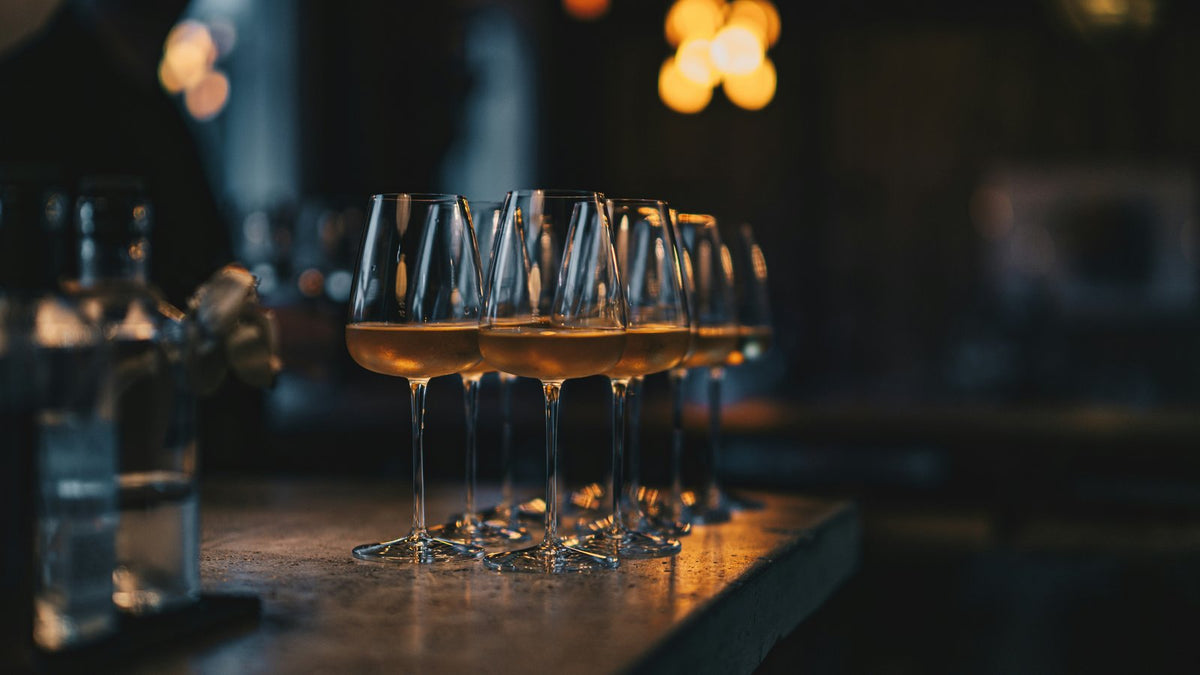
You have chosen a great bottle. How you serve it decides whether it shows everything it has. Three things matter far more than any gadget: the temperature in the glass, a little air when the wine needs it, and the right glass. None of them is complicated, and all of them are easy to get right.
1. Temperature: the setting that changes everything
Most reds are served too warm and most whites too cold. "Room temperature" dates back to cellars and unheated dining rooms; in a modern living room at 22–24 °C, a red tastes soft, flat and alcoholic. An over-chilled white, on the other hand, loses its aromas.
| Style | Serving temperature | Examples from our cellar |
|---|---|---|
| Champagne and sparkling wines | 6–8 °C (8–10 °C for prestige cuvées and vintage Champagne) | Marie-Le Brun Blanc de Blancs |
| Light, crisp whites and rosés | 8–10 °C | Domaine Lebreuil Bourgogne Aligoté Les Caillaux 2023, By Ott Rosé 2025, Château de Selle Rosé Cru Classé 2025 |
| Medium-bodied whites | 9–11 °C | Albamar Albariño 2025, Mas Alta Els Pics Blanc 2024, Egon Müller Scharzhof Riesling 2022 |
| Oak-aged whites | 11–13 °C | Hubert Lamy Saint-Aubin La Princée 2022, Hubert Lamy Saint-Aubin 1er Cru Clos du Meix 2022 |
| Light, fresh reds | 13–15 °C | Arpepe Rosso di Valtellina 2022, Passopisciaro Passorosso 2023, Arnaud Baillot Bourgogne Côte d'Or Pinot Noir 2023 |
| Medium-bodied reds | 15–16 °C | La Poderina Rosso di Montalcino 2024, Jacopo Biondi Santi Sassoalloro 2023 |
| Full-bodied reds | 16–18 °C | Fleur de Pédesclaux Pauillac 2020, Mas Alta La Basseta 2021 |
| Sweet wines | 8–10 °C | Château Suduiraut 2017 |
How to chill or warm it at home
- Whites and sparkling wines: about 2–3 hours in the fridge, or 15–20 minutes in an ice bucket filled with ice and water (water chills far faster than ice alone).
- Reds: 20–30 minutes in the fridge before serving brings a red down from room temperature to its ideal range.
- Too cold? Let the glass warm in your hand for a few minutes. It is easier to warm a wine than to cool it, so it is better to start slightly cool.
2. Decanting: when, why and for how long
There are two reasons to decant, and they call for opposite approaches.

To open up a young wine. Young, structured reds are often tight when first opened. Air softens the tannins and lets the aromas come forward. Pour the wine briskly into a wide decanter.
To separate an older wine from its sediment. Mature reds and vintage port throw a deposit. Stand the bottle upright for a day, then pour slowly and steadily, with a light under the neck, and stop as soon as you see the sediment reach the shoulder. Older wines are fragile: decant them just before serving, or simply pour carefully from the bottle.
| Wine | Decant? | How long |
|---|---|---|
| Young Barolo, Barbaresco, Brunello, Bordeaux and Priorat | Yes, for air | 1–2 hours |
| Young Rioja, Châteauneuf-du-Pape and reds from northern Spain | Often | 30–60 minutes |
| Red Burgundy, Beaujolais crus | Rarely; a brief airing at most | 0–30 minutes |
| Mature reds (over 15 years old) | Only for sediment | Just before serving |
| Fine whites (white Burgundy, Riesling GG) | Sometimes, if they seem closed | 15–30 minutes |
| Champagne | Usually not | — |
No decanter? Pour the wine into a clean jug and back into the bottle. Or simply open it an hour early and let the first glass breathe in the glass.
Wines from our cellar that reward an hour in the decanter: Produttori del Barbaresco 2020, La Poderina Brunello di Montalcino 2020 and Château Certan de May Pomerol 2019.
3. Glassware: the shape does the work
You do not need a different glass for every grape. One good set of thin, clear, tulip-shaped glasses covers almost everything. The bowl gives the wine room to release its aromas, and the slightly narrower rim gathers them towards your nose.
- Fill to the widest point of the bowl, usually about a third of the glass. That leaves room to swirl.
- A larger, rounder bowl flatters Pinot Noir and Nebbiolo, with their delicate, layered aromas.
- Serve Champagne in a white-wine glass rather than a narrow flute. You keep the bubbles and gain far more aroma.
- Hold the glass by the stem, so your hand does not warm the wine.
- Wash with hot water and little or no detergent, then polish dry with a cloth. Soap residue and cupboard smells dull the aromas and the bubbles.
4. Keeping an open bottle
Recork the bottle and keep it in the fridge, reds included: oxygen works more slowly in the cold. Take a red out 30 minutes before you pour it again.
- Still reds and whites: usually keep well for 2–3 days.
- Sparkling wines: 1–2 days with a proper sparkling-wine stopper.
- Sweet wines: often two weeks or more, thanks to their sugar and acidity.
A vacuum stopper or an argon spray can give you two or three more days.
Serve it well, then enjoy it

The right temperature, a little air and a good glass turn a great bottle into a memorable one. If you are not sure how to serve a wine from our cellar, write to us at info@vinfinesse.com and our sommelier will be happy to advise you.


